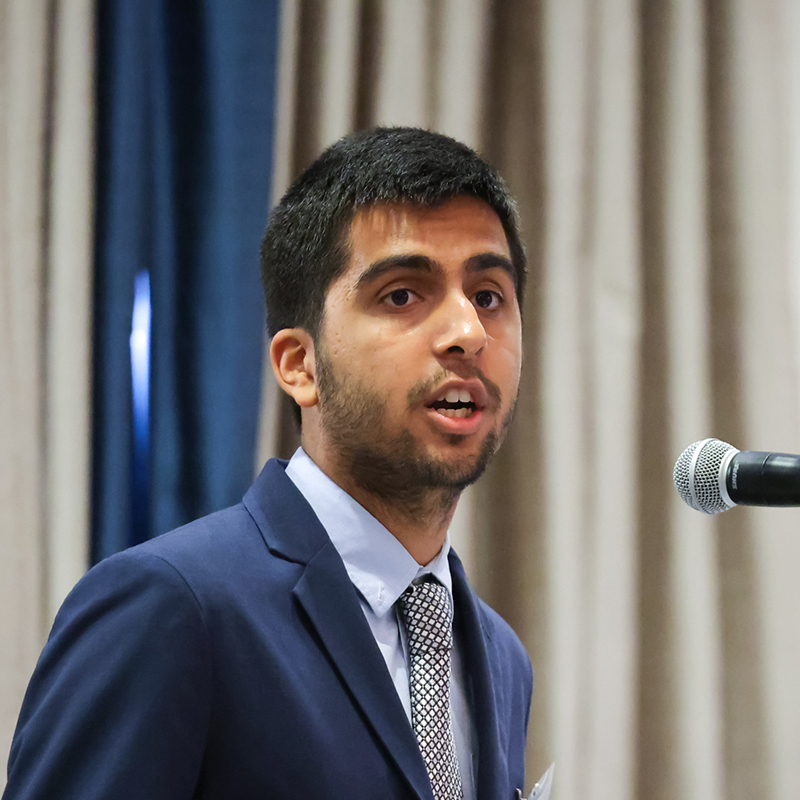
ARNAV GUNWANI
Class of 2025
Associate Consultant, KX Advisors
Looking back, what is one experience, relationship or lesson from the program that continues to influence your life or career today?
ARNAV GUNWANI: Going into the program, I had a sense of ambition. I had an idea that I wanted to do hard things and seek out challenges and all of that. But I think what I learned from the path that many of my peers took, which was to explore all of these different fields that felt interesting to them and then latch onto something that resonated with them personally, is just the importance of doing something that speaks to you on a certain level where you’re willing to be resilient for it, and you’re willing to not just chase challenges but do some of the more monotonous and mundane work to better yourself to take on whatever the next project is, whatever the next challenge is.
Some of my closest friends who were Luther Hodges Scholars were doing research on housing with the Gates Foundation. Now some of them are founding consumer health startups, helping make coffee supply chains more sustainable in Africa. All of these things are very specific opportunities that I think they sought out with a certain vigor and enthusiasm because there was something personally tying them to those missions, I guess. And for me, for the longest time I think I had tried to recruit into the jobs that everybody told me were good for me, and I tried to take a lot of paths in college that people told me were kind of what you’re supposed to do as a good student or as the next achievement that you’re supposed to have on your resume or whatever it is. But having made a switch then into a cause that I find that I’m deeply passionate about, which is for me the ability to help decisions about drug discovery be made better and be made anchored in what people really need and where the field needs to go — that is the kind of work that in my job now I help clients with — that is the kind of thing where frankly at 10 at night I’m still willing to work at that.
How has your understanding of leadership evolved since joining and now graduating from the program?
ARNAV GUNWANI: I think before joining the program, I felt like leadership was about authority and telling people to do things in an efficient manner. I think Luther Hodges Scholars introduced me to the idea that leadership is much more complex than that. It is a managing of relationships, of systems. And I mean, if you get all the way down to it, it’s about establishing things like purpose and culture that are, I think, some of the most advanced things that we have as a society, and it’s about using those to further a certain specific goal.
While I was in the program, I realized that leadership was a much larger undertaking than I’d previously thought. And now having graduated from the program and having exposure as a professional, I realized that leadership is in a way so large of an undertaking that it’s not just for leaders. Leadership is a distributed responsibility on any good team.
In what ways has the program shaped how you approach challenges, opportunities or decision-making in your professional life?
ARNAV GUNWANI: One of them is sort of what I touched on earlier, which is if the things you choose to work on or the challenges that you’re facing are things that are deeply important to you personally, then your ability to overcome them is just so much higher.
The other way that I think the program has affected how I approach challenges and opportunities is honestly just backing myself more and believing in my own potential. I have a tendency to place very successful people on a pedestal sometimes and wonder if I can do that, wonder if I can do what they do. And I think that’s a natural product of being someone that also wants to achieve those things. But through Luther Hodges Scholars, I talked to so many of these people that have accomplished these things. And some of them became my mentors. Some of them went out of their way to help me develop and give me learning experiences that were really valuable. And in the process of all those interactions, as much as they were absolutely brilliant people and their track record very much shows that, a lot of their stories came down to this idea of, again, being resilient and building up your strengths and doubling down on them and just doing that over a long period of time. And at the end of the day, I feel like that’s something I can do.
If you had a message for current and future scholars, what would it be?
ARNAV GUNWANI: Trust that the people that believe in you have better judgment about your abilities than you do. And that’s a bit geared toward people that tend to be hard on themselves like I do. But I was just talking to my mentor at work about this because we’re going through our review cycles and I’m in a period where I have to advocate for myself and all this. And I think people that I work with, or at least people that I’m close with at work, know that I have a tendency to play down my own achievements. But here’s this third-party person that thinks I can do something good. And if they think I can do something good, and I respect them and their judgment overall, then trust that they’re probably right and you probably have something going for you, and try to maximize that as much as possible.
Complete this sentence: “Because of this program, I …”
ARNAV GUNWANI: Because of this program, I feel inspired about my ability to make productive changes in my community.
Interviewed by Phil Hardy. This transcript has been edited for length and clarity.

Luther Hodges Scholars 10th Anniversary
“We’re developing the next generation of business leaders,” said Executive Director Kim Allen.
The program’s 10th anniversary celebration offers a chance to trace its evolution, from its earliest days as the Kenan Institute Leadership Fellows to the transformative program it is today.