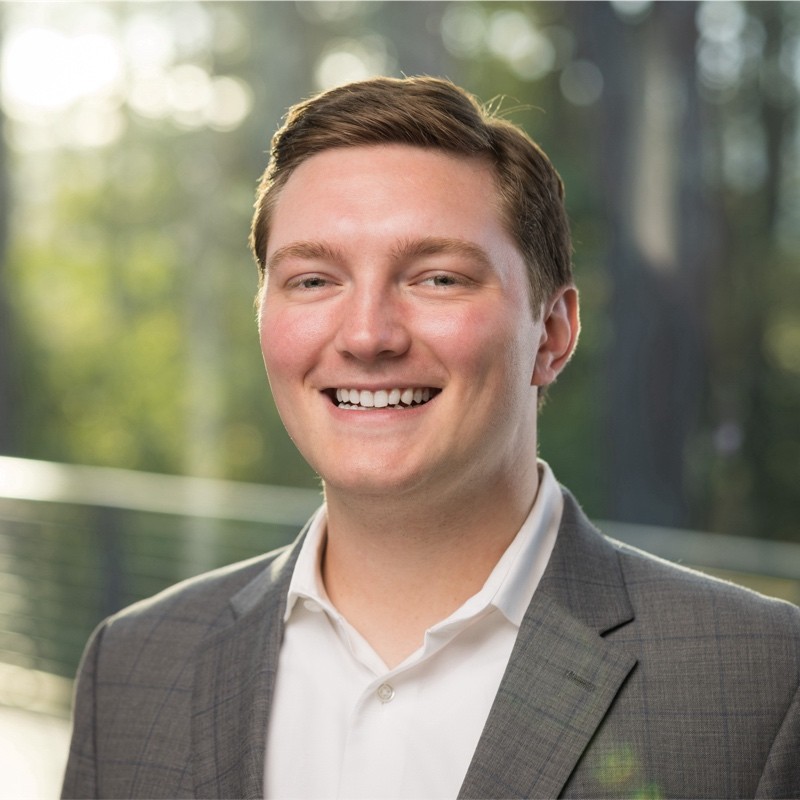
JACK NOBLE
Class of 2020
Consultant, L.E.K. Consulting
Looking back, what is one experience, relationship or lesson from the program that continues to influence your life or career today?
JACK NOBLE: I am pivoting into healthcare consulting in Atlanta, and before I was a product manager for a healthcare company. So staying in the same field but changing my functions a bit. And I think that’s a good tie-in to talking about the program because one experience that continues to influence my life and career today is my sophomore summer. I was able to intern with the Kenan Institute Asia in Bangkok, Thailand, and I worked as a public health analyst. And that is an experience that has continually stayed with me and shaped my trajectory in my life and career because I never considered a career in healthcare before that summer internship. And as a public health analyst, I worked with a few other students and staff at the Kenan Institute and was able to experience how business could improve access, education and healthcare outcomes. And it really gave me a new sense of direction. And that one experience over the summer kind of kickstarted my interest in the business of healthcare.
And then I came back to Carolina and as a senior with the Luther Hodges Scholars, I worked on an honors thesis that focused on Medicaid and Medicaid work requirements and what that could mean for hospital operating margins. After graduation, I worked as a product manager and worked on healthcare products designed to help people better manage their health. And from there, I knew I wanted a career in healthcare.
So just that one experience working in Thailand pushed me to think in a new way and pushed me to question what I wanted out of a career. And every step since that has really built on that same question I asked during that summer. And that’s how can business help more people access care and receive high-quality care so they can live healthier lives? And the Luther Hodges program gave me the opportunity to begin exploring that question. And it continues really to shape what I do today.
How has your understanding of leadership evolved since graduating from the program?
JACK NOBLE: My leadership philosophy has really pivoted away from thinking that leaders have all the answers to thinking that leaders have to define reality and inspire a vision. And when I think about what that means for me, leadership and defining reality means being honest about challenges and setbacks and uncertainty. And I think real leaders don’t shy away from hard conversations, but they really try to hold space for them and name the problem and give teams the space to think about what is happening around them. And so when you define reality, I think it shows that leaders are able to understand frustrations and concerns before deciding what the team should do. And then I think giving hope is inspiring a vision and giving hope is the next part that is really important as well. But I think that with setting the stage and setting reality, it’s on the leader then to help picture a better outcome and understand how a team can get there together. And I don’t think hope means ignoring what’s hard, but it means reminding people that the problem can be solved and that the work matters.
In what ways has the program shaped how you approach challenges, opportunities or decision-making in your professional life?
JACK NOBLE: The Luther Hodges Scholars program, I think, has taught me to approach challenges and opportunities with curiosity and especially curiosity if they do not really fit into a neat plan. I think my internship in Thailand is a good example of approaching something with curiosity because I didn’t think I was interested in healthcare, but I was willing to step into something unfamiliar and let it change my direction. And I tried to take that same approach of curiosity with me. And so when I approach a challenge, I like to ask a few simple questions to stay curious, like what problem are you trying to solve? Who’s affected by it? What does the data say? And I think the program has taught me to look beyond the most obvious answers and that listening to people, and listening to people from diverse backgrounds and experiences, and understanding that context and being willing to adjust when new information challenges your thinking is all important. And those are ways to stay curious and open. And so I think that the program gave me that confidence to explore with curiosity and take on unfamiliar challenges and also the discipline to think carefully through my choices.
If you could share one message with current and future scholars, what would it be?
JACK NOBLE: Stay open to opportunities that don’t fit into the plan that you have for yourself. It’s easy to be in the program and be at UNC and think about your future and what lies ahead. And that is important, to have a vision for yourself and a roadmap for yourself. But some of the most important and impactful experiences in your life won’t be the ones that you could have predicted. Careers and life really don’t unfold in a straight line. And so leaving room for curiosity can help you find work that matters to you and a path that you might not have seen before.
In one sentence, complete this statement: “Because of this program, I …”
JACK NOBLE: Because of this program, I found the purpose that has guided every step of my career.
Interviewed by Phil Hardy. This transcript has been edited for length and clarity.

Luther Hodges Scholars 10th Anniversary
“We’re developing the next generation of business leaders,” said Executive Director Kim Allen.
The program’s 10th anniversary celebration offers a chance to trace its evolution, from its earliest days as the Kenan Institute Leadership Fellows to the transformative program it is today.