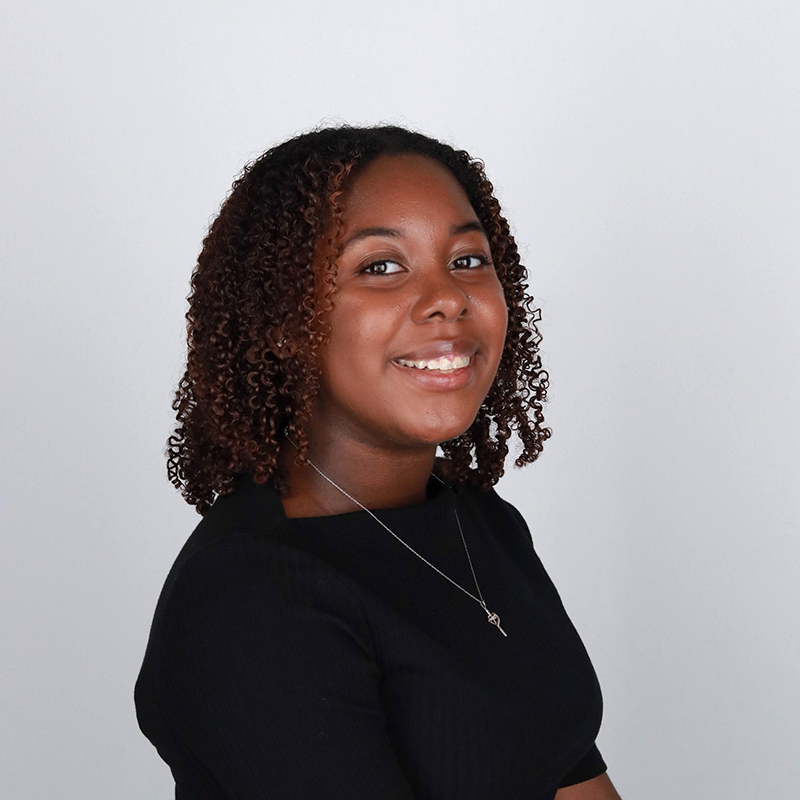
JASMINE BERRY
Class of 2026
Recruitment Operations Specialist, College of Agriculture and Environmental Sciences, North Carolina A&T State University
Tell me about one experience, relationship or lesson from the program that continues to influence your life or career today.
JASMINE BERRY: One lesson that I took with me from the program is definitely how to be adaptable and how to be flexible. I think I especially honed that skill during that sophomore cross-sector internship because I went out of the country for the first time on my own, which was a really great experience. I was there for two months. I really got to be immersed in the culture and understand the differences between American work life and Thailand work life.
It taught me a lot in being adaptable and kind of learning how to hone different skills and the importance of asking questions. I think a lot of the time we think that we don’t want to look like we don’t know anything, but as an intern, no one is expecting you to know everything about everything right off the bat and especially with a different culture. And I also don’t speak any Thai. And I was doing research on the Thai economy and I was, like, I don’t know what search terms I should be using here. So asking for help definitely was a huge lesson.
How has your understanding of leadership evolved as a result of being a Luther Hodges Scholar?
JASMINE BERRY: One thing that I learned is that you don’t always have to be in a leadership role to be a leader. Leadership is not a position. It’s more actions that you’re taking. When I first came to UNC before the program, I was like, OK, a leader is like a secretary in this club or they’re the president in this club, but you could be just a regular member in a club and still be a leader.
In what ways has the program shaped how you approach challenges, opportunities or decision-making in your professional life?
JASMINE BERRY: The program has made me a more well-rounded decision-maker. I think the focus on cross-sector collaboration really allows you to look at things from different perspectives before you come up with a solution. There are a lot of problems in the world that could be more easily solved if more people work together and more sectors work together. So when I look at problems now, I try to think of it from different perspectives so I can understand the root causes of the problem and all of the things that go into the problem in order to come up with a viable solution.
If you could share one message with current and future scholars, what would it be?
JASMINE BERRY: Definitely network as much as possible. Go to as many roundtable discussions [as you can]. Those were like super fun. I remember meeting the governor, and that was really great, just hearing all that he had to say about education and policy. Also, go on the Explorations. I went to Charleston. I had a great time. I got to explore the city and learn a lot about history and that was super fun, but also learn about the business in Charleston and how their economy is going. And I got to visit a school district. It was such a well-rounded experience where I got to learn about the different sectors and how they intersect to gain tourism and things like that in Charleston. Also just being in Charleston on the beach. That’s great. And it’s free. Why not go explore, experience as much as possible?
Finish the sentence: “Because of this program, I …”
JASMINE BERRY: Because of this program I’ve made a lot of wonderful connections, like Phil and Keith and Dr. Allen. They’re all so amazing. When I found out I no longer had a postgrad role, they were like one of the first people that I reached out to. I was like, hey, guys, do you have any connections in this industry? Is there anyone you can help me get in contact with. And so they have been just such an amazing resource. They’ve been such amazing people just to talk to.
How will you remember the program as you move forward?
JASMINE BERRY: I’m thinking I truly feel like the cross-sector experience is something that I’ll carry with me for the rest of my time.
Any other things that you would mention as you think back about the program, things that stick with you?
JASMINE BERRY: I definitely think one of my favorite parts when my schedule was less busy was going to those roundtable events and meeting different people talking about their career paths and how they progress. Most of those people had very out-of-the-ordinary career paths or very winding roads. They went and did something and they came back to something else and then they ended up doing something completely different. So I feel like those were really great and you got to ask questions that you were interested in about their life because you have that kind of more personal space where it’s only like maybe 10 to 15 scholars. I really, really enjoyed those and I wish I was able to attend more senior year but I was working 40 hours a week.
Interviewed by Phil Hardy. This transcript has been edited for length and clarity.

Luther Hodges Scholars 10th Anniversary
“We’re developing the next generation of business leaders,” said Executive Director Kim Allen.
The program’s 10th anniversary celebration offers a chance to trace its evolution, from its earliest days as the Kenan Institute Leadership Fellows to the transformative program it is today.