A Decade of Building Cross-Sector Leaders
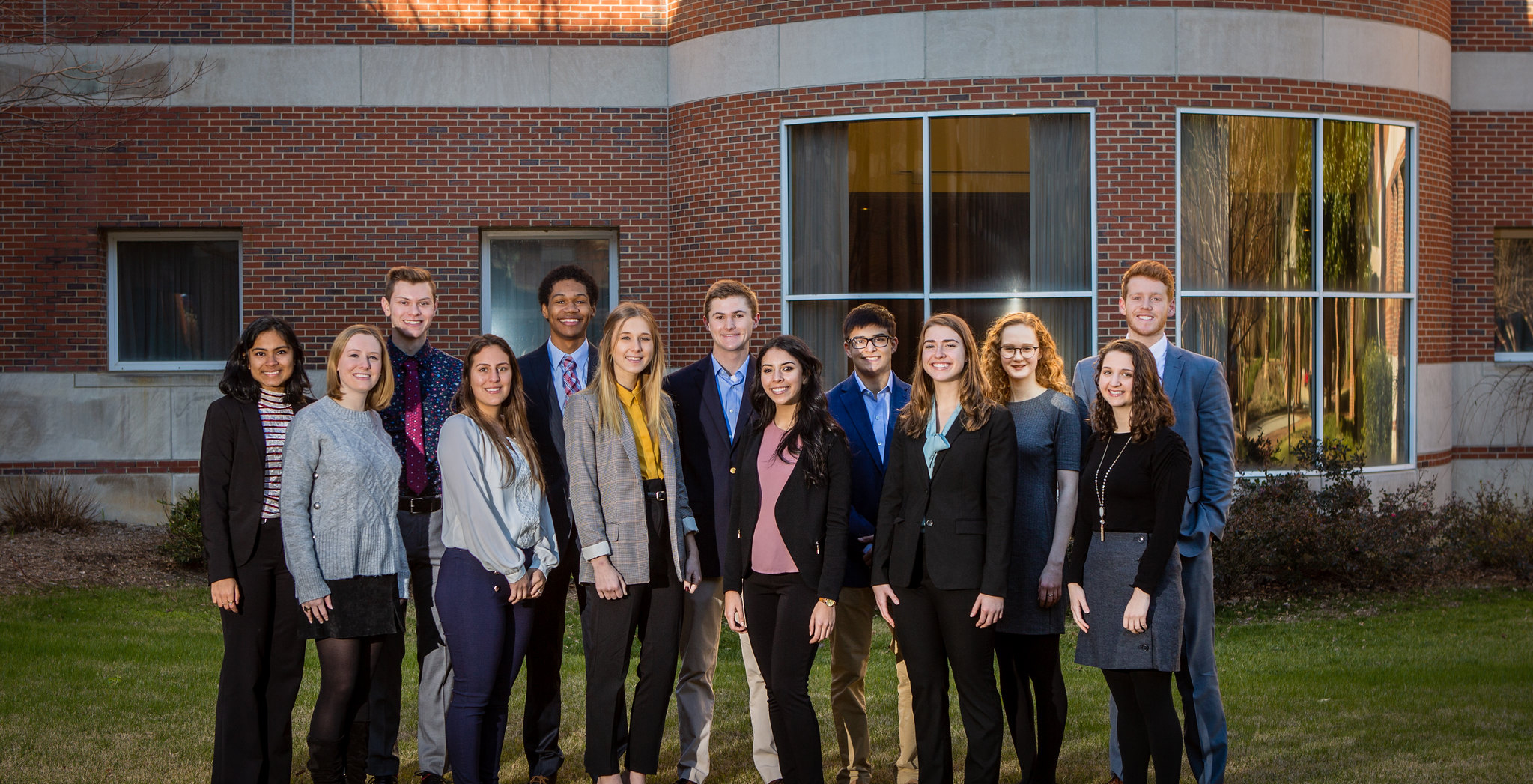
Photo: Scholars from the Class of 2021 attend Orientation Weekend in January 2019.
Luther Hodges Scholars past and present will unite to mark the group’s 10th anniversary October 7, alongside leadership, staff members and friends of the program. They’ll celebrate connections made, real-life lessons learned, experiences savored and milestones reached.
Like the scholars themselves, the Luther Hodges Scholars program has milestone achievements of its own. The biggest ones have taken it from a special leadership curriculum to a distinctive program with growing national reach that continues to evolve after a decade of change and growth. Luther Hodges Scholars is an intentionally developmental program designed to bring coursework, experiences and reflection together to develop scholars’ leadership, research and inquiry, and cross-sector collaboration capacities.
“We’re developing the next generation of business leaders,” said Executive Director Kim Allen.
The program’s 10th anniversary celebration offers a chance to trace its evolution, from its earliest days as the Kenan Institute Leadership Fellows to the transformative program it is today.
A Decade of Growth, A World of Possibility
As it enters its second decade, the Luther Hodges Scholars program remains closely aligned with the mission of the Kenan Institute of Private Enterprise. That connection helps shape leaders the program produces, Allen said.
They understand markets. They use evidence to navigate complexity and make sound judgments. And they recognize when cross-sector collaboration — business, government and civil society working together — is necessary to create economic opportunity and improve lives.
The program has evolved alongside the needs of its scholars, creating new opportunities for leadership, professional growth and real-world experience. That growth is reflected in the program’s reach: Applications have increased 251% since 2019, from 39 applicants to 137 in 2025, while 141 alumni now span the United States and seven countries.
It has invested deeply in experiential learning, funding more than 25,000 internship hours and more than 130 personalized professional development experiences, from research opportunities and conferences to training and certifications.
Allen, Faculty Advisor Greg Brown and institute Chief Economist Gerald Cohen, who each teach one of the program’s three courses, participated in strategic planning over the summer, examining what the next decade should look like. Their conversations centered on a simple but important question: What kind of business leaders does the world need now?
“We want to affect the kind of business leaders that are coming out of business schools,” Allen said. “Over the next decade, we want our model of developing these leaders to expand to other schools.”
The program’s growing alumni network offers a glimpse of what that future can look like. Across the country, alumni are building careers, staying connected to one another and giving back through mentorship, programming and professional support. Alumni gatherings in Chapel Hill and cities across the country create a full-circle experience in which alumni return to share their expertise and mentor program scholars.
“My hope is that we continue to build a community of alumni that are well connected, so people that maybe didn’t even know each other in school become connected and share this common bond of having been involved with the program,” Brown said.
The skills that the scholars program instills in students or emphasizes within students, of the importance of being able to communicate and generate a sense of urgency across stakeholders with really different interests and motivations, are something that’s top of mind for me.
— Jordan Mareno, Class of 2019

2016
Adding the Undergraduates
Brown, the Van and Kay Weatherspoon Distinguished Professor of Finance at UNC Kenan-Flagler Business School, became executive director of the Kenan Institute in 2015, and he arrived with a mandate: Take a top-to-bottom look at the 30-year-old organization.
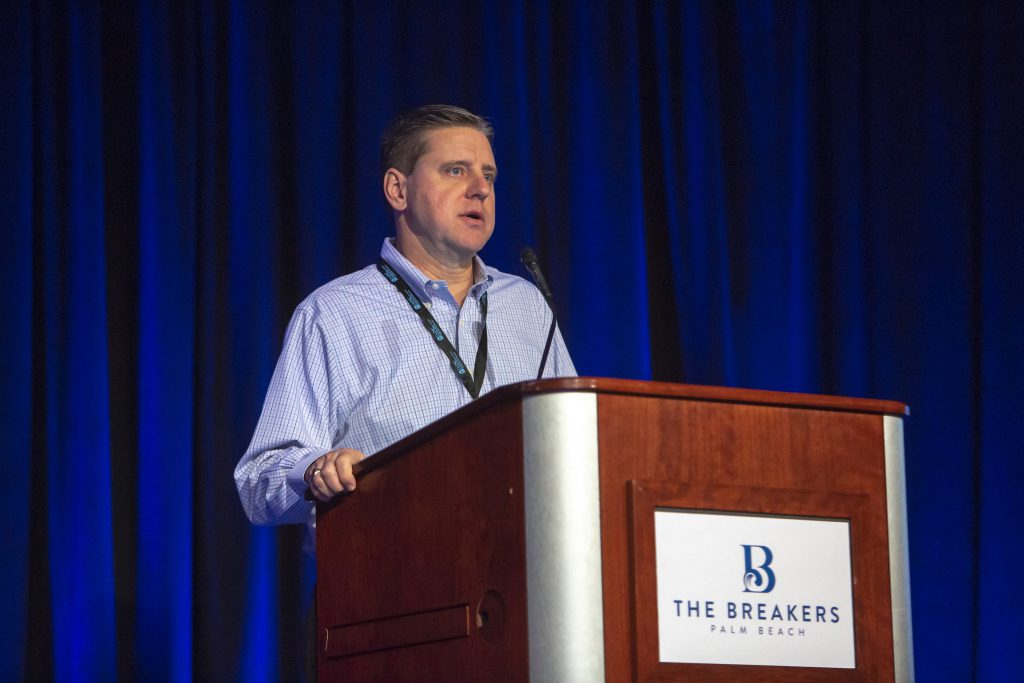
Scholars Faculty Advisor Greg Brown led the Kenan Institute of Private Enterprise when the Kenan Scholars launched in 2016.
“Figure out what made sense, get rid of the stuff that didn’t,” said Brown, who served in the role until 2023.
Among the areas he looked at was the student-facing component of the institute’s work. The Kenan Institute Leadership Fellows launched in 2005, providing the opportunity for a select group of MBA students to get real-world experience. In 2016, the Leadership Fellows became the Kenan Scholars, the forerunner of the Luther Hodges Scholars.
Supply and demand moved the institute to involve UNC Kenan-Flagler’s undergraduates, Brown said. “The MBAs have an enormous wealth of opportunities afforded them in terms of programming,” he said. Undergraduates had fewer activities to choose from at that time, and Brown saw a real appetite for new options.
Class sizes were capped at 25. Rising sophomores applying to UNC Kenan-Flagler as business administration majors or minors were eligible to apply.
“We had the broad outline of what we wanted the students to get out of it,” Brown said of the new undergraduate program. “But the actual operational mechanics, you know, took a while to develop.”
Figuring out those particulars and a structure fell to Allen, who was hired in 2017 to lead the new undergraduate component, which had already welcomed its first class. She joined Lingmei Howell, the longtime leader of the MBA scholars.
Programming for the undergraduate scholars began with workshops and training, but the decision soon was made “to package some of our programming into courses so they could at least get course credit for their participation,” Allen said. The program’s academic component started as one course, later growing to three.
“We had a foot in the Kenan Institute and a foot in the Undergraduate Business Program, not only because these are the same students, but now we had courses which created another point of connection,” Allen said.
Two more significant developments followed. Phil Hardy arrived in 2019 as a student advisor and remains with the program today as assistant director of external relations. And in 2021, the MBA portion of the program was dropped, leaving UNC Kenan-Flagler undergraduate business majors and minors as its sole focus.
It’s easy to be in the program and be at UNC and think about your future and what lies ahead. And that is important, to have a vision for yourself and a roadmap for yourself. But some of the most important and impactful experiences in your life won’t be the ones that you could have predicted.
— Jack Noble, Class of 2020
2022
Time to Refine
2022 marked an opportunity to pause and take stock. Five years into the Kenan Scholars program, leadership initiated a formal review to assess the program’s progress, clarify direction and benchmark success factors.

The five-year review gave the program an opportunity to reimagine how it prepares scholars for careers that bridge industries, disciplines and sectors. What it revealed pushed its leaders to ask deeper questions about its purpose, its role and how it could best serve current and future scholars.
The review committee was chaired by Chuck Lovelace, a nationally recognized scholar program leader. Lovelace was executive director of the Morehead-Cain Foundation, which funds UNC-Chapel Hill’s Morehead-Cain Scholars program, from 1987 until his retirement in 2021, and he remains an advisor for both the Kenan Institute and the Luther Hodges Scholars program.
Lovelace gathered leaders from other scholar programs to take a close look at the Kenan Scholars. Their outside perspective offered both validation and a candid assessment of where the program needed to grow.
“It was clear from our conversations during the review that the Scholars gained valuable skills, perspective, and experience from the program,” Lovelace wrote in an email. “The Scholars were drawn to the program because of their interest in public service through business. The program reinforced this interest and broadened their perspective on career paths that might be less traditional but equally impactful.” That finding helped inform the program’s subsequent evolution toward a broader cross-sector leadership model.
A lean structure supported the program’s early growth but created challenges as its scope and ambitions continued to expand. One of the committee’s clearest conclusions was that those ambitions had outpaced the program’s capacity to support them.
While challenging to hear, the assessment created an opportunity to better align the program’s vision and mission with its resources while underscoring the need for additional operational support. In many ways, these growing pains reflected the program’s success. As its ambitions expanded, so did the opportunities it was able to create for scholars.
Lovelace noted that the review committee “recommended some changes to the internship objectives and program curriculum, which were accepted and implemented, but overall, we came away energized by the program’s potential to offer a unique experience for undergraduate business majors.”
The program impacts who you meet and also helps you understand how the private sector and the public sector overlap and really allows you to find your passions. I think a lot of students at UNC get really into this rhythm of going for the same types of roles, whether that’s in consulting or investment banking or real estate. And the program really encourages you to push those boundaries and explore new roles.
— Anna Manocha, Class of 2022
2023
A Transformational Gift
2023 ushered in a new chapter for the program, fueled by a gift from Carolina alumnus Luther H. Hodges Jr. and the renaming of the program in honor of the Hodges family. The gift established a permanent source of support, allowing the program to build on its foundation, expand its vision and create opportunities for generations of scholars to come.
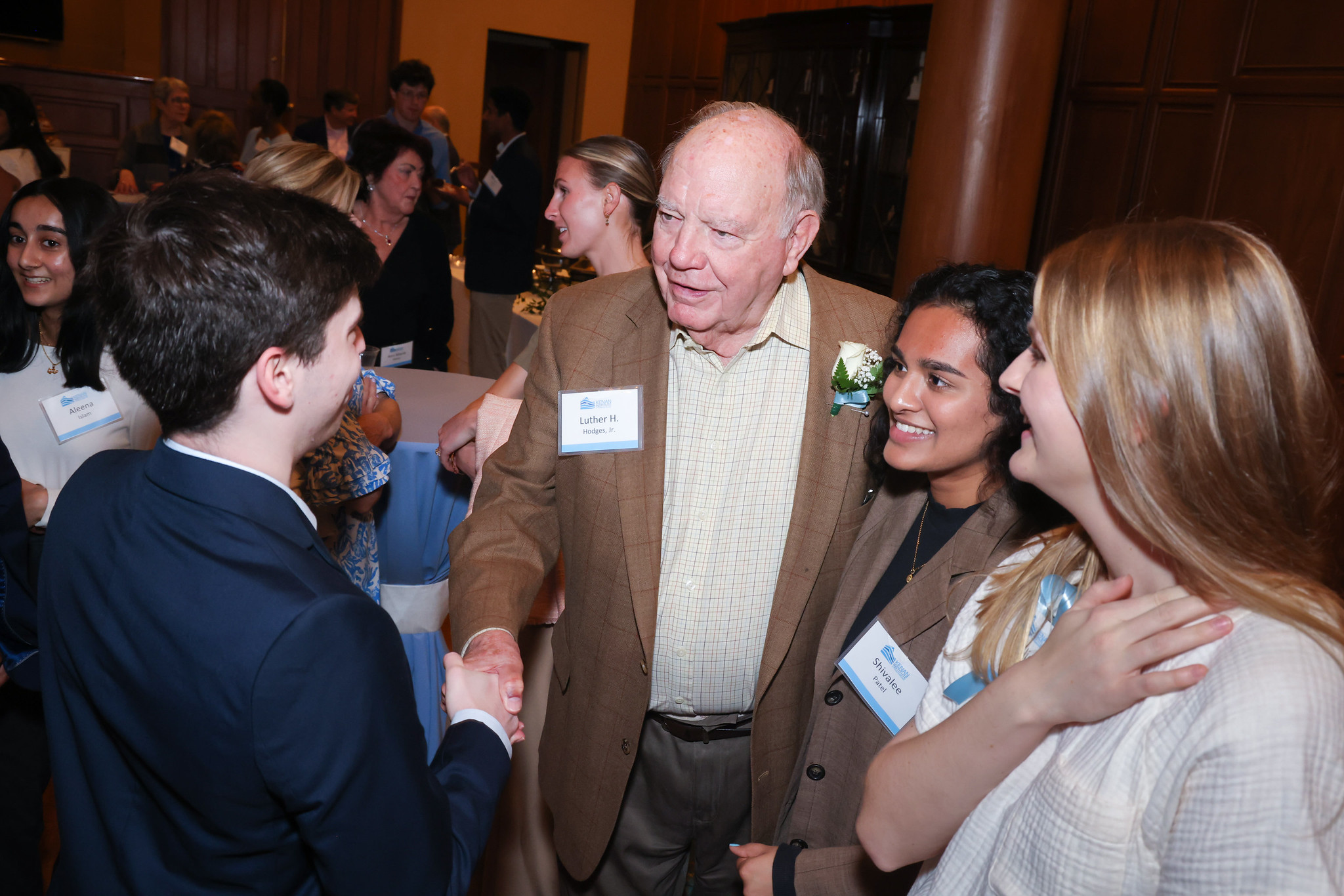
Luther H. Hodges Jr. talks to scholars during a March 2023 celebration of the naming gift that launched the Luther Hodges Scholars.
Both Luther H. Hodges Sr. and Luther H. Hodges Jr. built careers at the intersection of business, government and public service, mirroring the program’s commitment to prepare scholars to lead across sectors. It’s a legacy that connects the Hodges family to the program and helps explain why the family chose to invest in its future.
Hodges Sr., a UNC-Chapel Hill graduate and former governor of North Carolina, played a pivotal role in shaping the state’s economic future. As governor, he championed a stronger business climate and helped establish the nationally recognized Research Triangle Park, laying the groundwork for what would become a collaborative center of innovation and economic development. He later served as US secretary of commerce and as chairman of the Research Triangle Foundation.
Like his father, Luther H. Hodges Jr. built a career that bridged business and public service. After receiving a Bachelor of Arts in economics from Carolina in 1957 and earning an MBA from Harvard University, Hodges Jr. joined North Carolina National Bank, where he rose to chairman of the bank’s board. He later moved into politics and public service, running for US Senate and serving as deputy secretary of commerce under President Jimmy Carter.
“The Hodges family is known not only for their success in business, but also for their unwavering commitment to public service and higher education,” said former UNC-Chapel Hill Chancellor Kevin M. Guskiewicz at the time of the gift’s announcement in 2023.
The family’s gift expanded the program to provide scholars with new experiential learning opportunities such as cross-sector internships and immersive alternative breaks, expanded staff support, enhanced mentoring and professional development.
For scholars, those changes meant a program that could offer more than a traditional scholarship experience.
The program really helped me become more open-minded and have strong discussions based on real arguments and data, rather than opinions or perceptions. And I think it’s a big part of leadership.
— Gui Marinho, Class of 2024

2024
Building Leaders Through Cross-Sector Experiences
Like the Kenan and Hodges families, the Cannon family has longstanding ties to both North Carolina and the University of North Carolina. The family’s legacy grew from Cannon Mills in Kannapolis, which became the world’s largest manufacturer of towels and sheets, and includes alumni connections and service to the university as trustees.

The Cannon Family Charitable Trust Cross-Sector Internship gives students an opportunity to learn how different sectors can work together to approach complex challenges.
And like the others, the Cannons have long championed leadership, education and economic opportunity. Those connections to North Carolina, higher education and workforce development made the Cannon family’s support of the Luther Hodges Scholars program a natural fit.
In 2024, a new partnership with the Cannon Family Charitable Trust strengthened and expanded the program’s model for learning beyond the classroom. Building on an earlier investment in the program, the trust made a five-year commitment to support the next phase of experiential learning.
This cornerstone of the scholars program, once limited to the public sector, has evolved into a cross-sector experience designed to help scholars apply the program’s core competencies in real-world settings. Renamed the Cannon Family Charitable Trust Cross-Sector Internship, these experiences are designed to give students an opportunity to test their interests, perspectives and skills in professional environments while learning how different sectors can work together to approach complex challenges.
“The Cannon Family Charitable Trust has focused on trying to support education as its main focus, and specifically nonprofit internships,” said co-trustee Kathleen Cannon. “And the Luther Hodges Scholars Program really emphasizes the importance of a cross-sector approach.”
Students leveraged relationships established through the Cannon Family Charitable Trust to intern as teams at partner organizations on a variety of cross-disciplinary projects. The cohort experience was grounded in collaboration, giving scholars the opportunity to work across sectors while learning from one another.
Beyond increasing their networks, the grant enabled the program to increase internship stipends by $3,000, helping offset financial burdens and allowing scholars to focus more fully on their internship experiences.
The Cannon investment also opened the door to four new partner organizations, expanding the range of internship experiences available to scholars: Children’s Home Society of North Carolina, the Orange Bowl, the Crockett Foundation and Truist Foundation, which became the program’s first corporate-sector partner.
Taken together, these changes reflect a broader evolution in the program, one that uses internships not only as professional experiences but also as opportunities for scholars to build connections and explore different sectors. For scholars, the importance of the internship is undeniable.
This summer I’m currently in Arizona working with a team of Luther Hodges Scholars, and we’re working for the National Center of American Indian Enterprise Development. It’s been really awesome to see the web of alumni and industry connections that the program has that really are a testament to this web of cross-sector collaboration and the program’s strength.
— Ellie Reynolds, Class of 2028
Written by Leslie Anne Frye-Thomas and Rob Knapp with contributions from Phil Hardy and Fred Trevino
Luther Hodges Scholars: The Next Chapter
As we celebrate 10 years of Luther Hodges Scholars, we are also looking ahead. Through a yearlong strategic planning process engaging scholars, alumni, faculty, staff, Advisory Council members and partners, we are sharpening our understanding of what makes the Hodges experience distinctive and how we can deepen its impact. That work is already shaping the program, from developmental coaching and a redesigned Cross-Sector Internship and Showcase to greater integration across our coursework and experiences. Looking ahead, we see opportunities to strengthen our distinctive approach to cross-sector leadership, deepen research and inquiry, expand meaningful partnerships and experiences, strengthen our community, and extend the program’s impact and reach. Ten years in, we are building on a strong foundation for an ambitious next chapter.
Kim Allen
Luther Hodges Scholars executive director